
Ordinary Seaman (OS) Jobs at Sea: Verified Maritime Vacancies with Salary and Joining Dates
Ordinary Seaman (OS) Jobs at Sea: Verified Maritime Vacancies with Salary and Joining Dates
By Michael Thornton
Every week, thousands of people who have never set foot on a ship start searching for a way into the maritime industry, and the most common first search is for an entry-level deck job. If you are one of them, the path usually begins with a single rank: the Ordinary Seaman. Browsing current os vacancies is the practical starting point, but understanding what the rank involves, what it demands and how to tell a good posting from a poor one will decide whether your first contract becomes a career or a costly mistake. SeaJobs.pro, a global platform for seafarers and crewing companies, lists openings from verified crewing agencies so that candidates can compare them side by side, and this guide explains how to read those listings with a critical eye.

What an Ordinary Seaman Actually Does
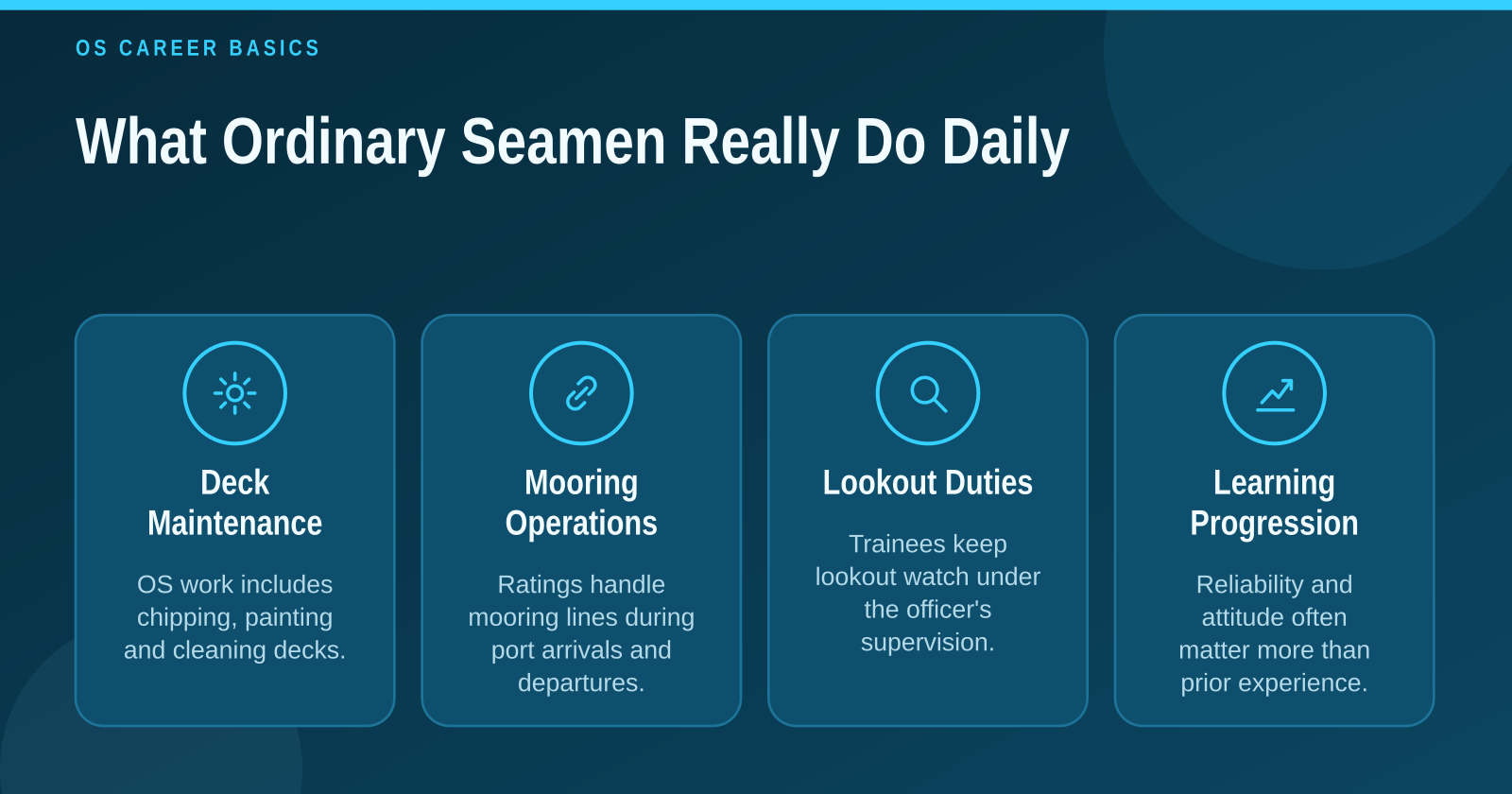
The Ordinary Seaman, usually abbreviated OS, is an entry-level deck rating. In the hierarchy of the deck department he sits below the Able Seaman, who holds a higher qualification and carries more responsibility for navigation watches, cargo operations and the supervision of other ratings. The OS is the person who learns the ship from the ground up, and much of the daily work is physical: chipping and painting, cleaning decks and accommodation spaces, handling mooring lines, assisting with cargo lashing, and keeping equipment in working order. Many ships’ routines depend on OS labour more than outsiders realise.
- Conflict on board is common in a confined environment, and the OS who handles disagreements calmly and raises concerns through the proper channels tends to be retained
- Home sickness, fatigue and the monotony of long passages are normal experiences rather than signs that you have chosen the wrong career
- Start by getting your documentation in order, because a current medical, valid STCW certificates and a clean, verifiable CV open far more doors than any amount of enthusiasm
- Expect a difficult first contract, and treat it as a training period rather than a verdict on your suitability for the sea
Watchkeeping is the other major responsibility. Depending on the vessel and the company’s manning scale, an OS may stand a lookout or helmsman duty under supervision, assist the officer of the watch, and log routine observations. These tasks are not decorative. A lookout who recognises a fishing boat drifting across the bow or a light that should not be there is doing exactly the job that keeps a crew out of a collision report. The OS is therefore not simply a labourer; he is a trainee whose competence is assessed at every watch.
Because the role is entry-level, the expectations are clear: you will be asked to work hard, learn quickly and accept direction without argument. Experienced masters and bosuns tend to judge a new OS within the first few days of a contract, and they look for reliability more than for prior knowledge. Someone who arrives on time, keeps tools organised and asks sensible questions often progresses faster than someone with a better certificate but a careless attitude.
It is worth being honest about the demands. Contracts commonly run for several months, followed by a period of leave, and the rotation schedule determines how much time you actually spend at home. Life on board means shared cabins, long hours in noise and heat or cold, limited internet access and separation from family and friends. Psychological resilience matters as much as physical strength. Candidates who thrive are usually those who can structure their own free time, stay in touch with home in a disciplined way and accept that the ship’s timetable, not their personal preference, governs the day.
Core Requirements and Qualifications
Before applying to any vacancy, you need a set of documents that verify you are fit and trained to work at sea. The foundation is the STCW Basic Safety Training package, which normally includes personal survival techniques, fire prevention and firefighting, elementary first aid, and personal safety and social responsibilities. These certificates have validity periods and must be current on the day you join. A crewing manager reviewing your file will check expiry dates before anything else, so an almost-expired certificate can disqualify an otherwise strong candidate.
Identity and travel documents come next. A valid seafarer’s identity document, which is recognised under the ILO Seafarers’ Identity Documents Convention, is often required alongside a full passport with sufficient remaining validity. Some ports and flag states also expect a yellow fever vaccination certificate, particularly for crew who will visit certain regions. Requirements differ between flag states and between companies, so the checklist supplied by the crewing agency is the authoritative guide for any particular contract.
The seafarer’s medical certificate deserves special attention. Under the ILO Maritime Labour Convention 2006, a pre-employment medical examination assesses whether you are physically and mentally fit for the duties of your rank. The examination covers vision, hearing, colour perception, general physical condition and, in many cases, the ability to climb ladders and work at height. Colour vision is a frequent stumbling block for deck work because navigation lights and signal flags must be identified correctly. Because a medical certificate has a limited validity period, timing matters: an application submitted with a certificate that expires before the joining date will usually be rejected, and renewing a medical at short notice can cost you a placement.
A medical certificate that is valid on the day you apply is not the same as one that will still be valid when you step aboard. Check both dates before you commit to a joining schedule.
Experience and education form the last layer. Some candidates enter through maritime academies or cadet programmes, which provide structured training and a clear route toward officer ranks. Others come through vocational courses at training centres, and a smaller number are hired directly without any prior sea time, usually because a crewing agency has a specific need or a relationship with a training provider. Sea service counts toward promotion: the months you spend as an OS are recorded in your discharge book and form the basis for applying for Able Seaman certification once you meet the minimum service requirements. Starting with no sea time is not a barrier to hire, but it does mean the first contract is an extended learning period, and realistic expectations will help you avoid frustration.
How to Choose an Ordinary Seaman Vacancy
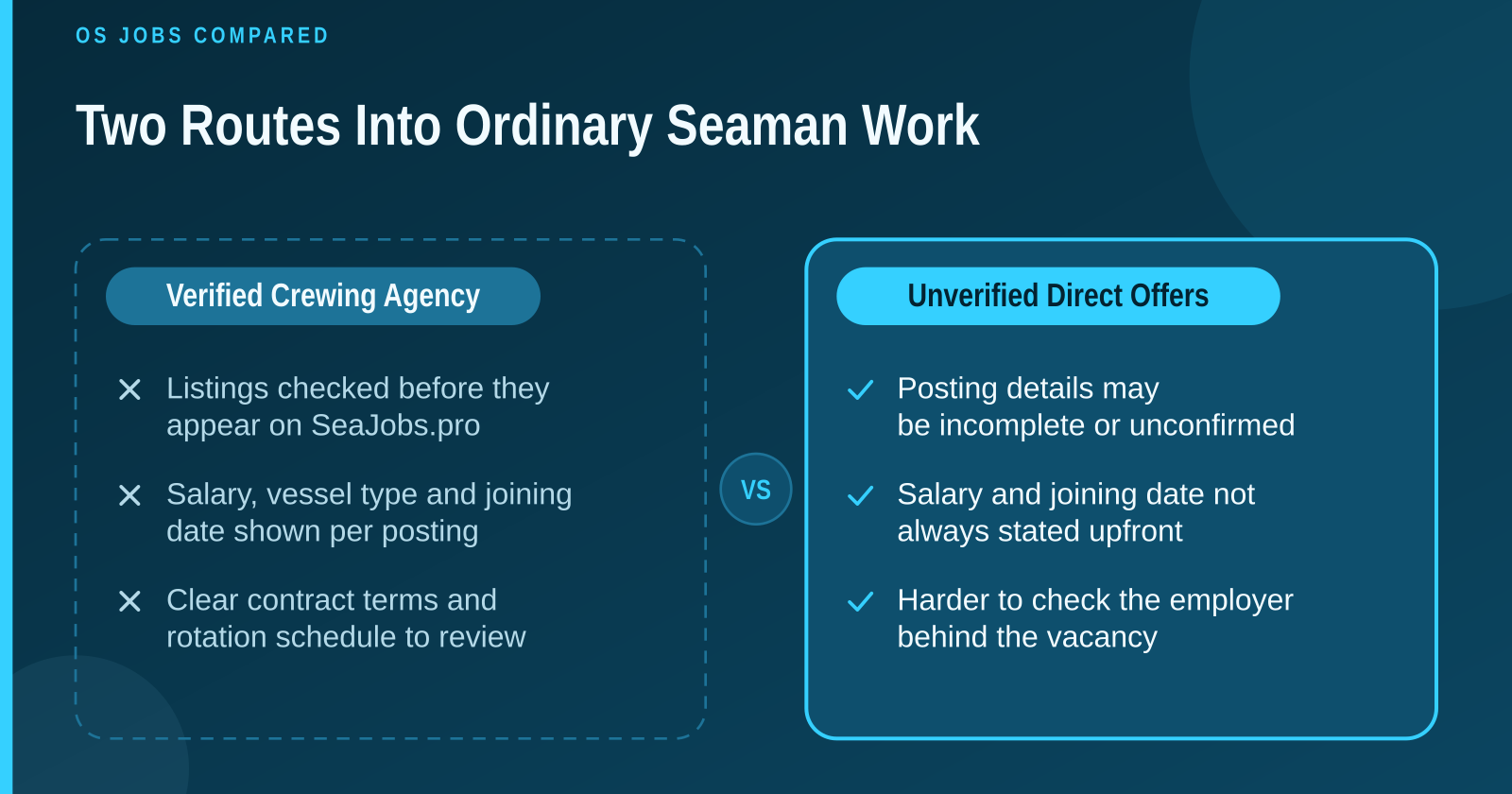
Choosing between postings requires looking past the headline salary. The first question is the employer. A crewing agency that is licensed in its jurisdiction, operates in line with the MLC 2006 and is recognised by the relevant flag states is far more likely to deliver what it promises. Ask for the agency’s licence details and check whether the principal company is named in the contract. If an agency cannot or will not give you this information, treat that as a warning.
Red flags are usually recognisable. Legitimate crewing companies do not charge seafarers an upfront fee for a guaranteed placement, and they do not pressure candidates to pay for a “priority slot” or a “fast-track” process. Contracts with vague terms about wages, overtime, leave or repatriation are another warning sign, as is a recruiter who will not discuss the vessel’s name, flag or trading pattern. Reviewing the agency’s track record, looking for consistent feedback from former crew, and confirming that the contract references a recognised dispute-resolution route will show you how the company behaves when things go wrong, which is the moment that matters most.
Vessel type shapes the experience more than most candidates expect. A bulk carrier typically involves heavy cargo-related work and long periods at sea with limited port time. Tankers bring their own discipline around cargo handling, safety procedures and strict regulation, and an OS on a chemical tanker will face more rigorous rules than one on a general cargo ship. Container ships tend to have fast turnarounds and busy port schedules, which means frequent mooring work and less rest between ports. Offshore support vessels and anchor handling tugs run operations that can be intense and weather-dependent, while car carriers and Ro-Ro vessels involve lashing, ramp work and short port calls. Ro-Ro and car carrier deck work is often described by seafarers as hard but predictable, while offshore work can be irregular but well paid.
Trading pattern is the other variable. Deep-sea voyages keep you away from port for weeks and can offer longer continuous periods of work, while coastal and short-sea trading often gives more frequent port visits and sometimes more regular home time. Match these patterns to your priorities. If you want to build sea time quickly and have strong tolerance for long passages, deep-sea work may suit you. If you value shorter separations from home or want to see more ports, coastal or short-sea routes may be better. Matching vessel type and trading pattern to your personal goals is one of the most effective ways to avoid leaving a contract early.
Compensation needs careful reading. A quoted monthly salary is often the basic wage only, and the figure you actually receive depends on overtime, leave pay, allotments and deductions. Some listings state a range of wages, such as the roughly 1,000 to 1,500 USD bands that appear on some postings, and others quote in euros, pounds or zloty. Before you accept, confirm the currency, whether overtime is paid at a fixed rate, how leave pay is calculated, and which costs such as travel, visas and medical examinations are covered by the employer. Contract length and leave ratio matter too: a longer contract with a generous leave ratio can deliver more home time than a shorter one with a higher headline rate. Where a vessel operates under an ITF-approved collective agreement, the terms on minimum wages, overtime and repatriation are usually more transparent and enforceable, which is a meaningful protection for entry-level crew.
Step-by-Step: From Application to Joining the Vessel
Preparation starts with a CV that crewing managers can verify quickly. Use the format common in the industry, listing your certificates with issue and expiry dates, your medical certificate details, your passport and seafarer’s identity document numbers, and your sea service history with vessel names, types, flags and dates. Vague or incomplete sea service entries are a frequent cause of delay, because the manager must verify each claim against your discharge book or previous employer records. Gather scanned copies of everything in advance so that you can respond to requests without waiting days. For seafarers who are just starting out, browsing current os vacancies on SeaJobs.pro is a practical way to see which manning scales, vessel types and contract lengths companies actually offer before committing to a training path.
If documents are missing, the timeline for obtaining them can be significant. A basic safety training course may take a week or more to schedule, a medical examination depends on clinic availability, and a visa or yellow fever certificate can add further time. Plan these steps before you apply to vacancies with near-term joining dates, because a placement that falls through due to a missing certificate is one of the most common disappointments for candidates. Starting early also means you can be ready when an opportunity appears rather than scrambling for documents after an offer arrives.
The application process itself usually follows a predictable sequence. An initial screening checks that your certificates, medical and sea service meet the minimum requirements. This is often followed by a short technical interview, which for an OS tends to cover basic seamanship, safety awareness and your motivation for going to sea. Document verification then confirms your identity and certificates against originals or official records. Once the employer is satisfied, you will receive a contract, and this is where you must read carefully. Review the Seafarer Employment Agreement line by line, paying attention to wages, overtime calculation, leave, notice periods, repatriation terms and the dispute process. Ask about anything you do not understand before you sign, because a clause that seems minor in the office can become significant on a long voyage.
Joining logistics bring their own variables. The time between application and joining can range from a few weeks to several months, depending on the vessel’s schedule, the agency’s pipeline and the flag state’s requirements. Visa and travel arrangements, flights to the port, and pre-joining briefings are typically organised by the agency, but you should confirm who books and pays for each item. Joining dates are sometimes uncertain because vessels are delayed by port congestion, cargo changes or technical issues. Plan around this by keeping your finances stable, staying in contact with your agency and avoiding commitments that cannot be easily rearranged.
Common Mistakes Ordinary Seamen Make and How to Avoid Them
Documentation errors are the most avoidable problems. Expired medicals, certificates that the flag state does not recognise, and mismatched names or dates between your passport, seafarer’s identity document and certificates can all stop an engagement. Inconsistencies between your CV, sea service book and certificates are equally damaging, because they raise doubt about the entire file. A simple habit prevents most of these issues: once a month, check every expiry date, compare your CV line by line against your records and keep a folder of certified copies that you can send at short notice.
Financial pitfalls are harder to spot. Paying recruitment fees to unlicensed intermediaries is the classic trap, particularly when the intermediary promises a guaranteed contract or a faster route to a vacancy. Legitimate employers and licensed agencies generally do not require candidates to pay for a placement. Misunderstanding overtime calculations is another frequent problem: some contracts pay overtime only above a stated hour threshold, some apply fixed rates, and some deduct allotments or charges that reduce the net figure. Currency conversion can also erode income if wages are paid in a currency that fluctuates against your home currency. Ask for a written example of a typical monthly pay slip before you accept an offer, so that you know what the numbers mean in practice.
Behavioural mistakes can end a contract just as effectively as documentary ones. New crew who ignore safety instructions, arrive late for watches, or fail to communicate problems to senior ratings quickly lose the trust of the team. Keeping a simple personal log of your sea service, training and any incidents also protects you if a dispute arises later.
Realistic expectations help you avoid the disillusionment that causes many early departures. The first contract is usually the hardest, because everything is new and the physical work is demanding. Set small goals, such as mastering knots or learning the lookout procedures well, and track your progress. Many experienced officers started as OS and say that the discipline and humility learned in those first months shaped their careers.
Conclusion: Turning an Entry-Level Rank into a Maritime Career
The Ordinary Seaman rank is the doorway into the deck department, and the decisions you make at this stage shape the years that follow. Then evaluate each vacancy on its merits: check the agency’s licensing and reputation, read the contract closely, compare the vessel type and trading pattern against your goals, and calculate the realistic take-home pay rather than relying on the headline figure. Avoid anyone who asks for an upfront fee or refuses to explain the terms in writing.
Once you are on board, your conduct matters as much as your certificates. Learn from the Able Seamen and officers around you, take safety seriously, communicate early when problems arise, and keep records of your sea service because it will be the foundation of your promotion. The seafarers who build lasting careers are those who approach the entry-level role with patience, honesty and a willingness to be taught.
If you are ready to take the next step, review the current options carefully, prepare your file thoroughly and choose the posting that fits both your skills and your life outside the ship. Your first Ordinary Seaman contract is not just a job; it is the beginning of a profession that rewards those who stay the course.