
Fairy Tales for Children: Read Modern Stories Online Free
Fairy Tales for Children: Read Modern Stories Online Free
By Michael Thornton
Picture a school-night evening in a terraced house in Manchester. The children are in pyjamas, one is asking for a story about a dragon who is afraid of the dark, and the parent is weighing up a £7 paperback against a free online library on the family tablet. This small decision happens in millions of British homes, and it is worth getting right, because the right story at the right reading level can turn a restless bedtime into a settled one. Reading online for free has become a routine part of family life across the UK, alongside public libraries in Birmingham, London and Leeds and the reading schemes used in schools. bedtime stories for kids are now easy to find, but easy to find is not the same as easy to choose well.
This guide is written for UK parents, primary school teachers, childminders and family-learning professionals who want a practical way to judge free online fairy tale libraries. The Modern Fairy Tales portal is one example of the kind of resource we will examine: a collection of 497 stories by modern authors, with illustrations and audio versions, and a notification option for new releases. We will use it as a reference point, but the criteria here apply to any library you might open on a shared device. The aim is to help you decide what to read, how to read it, and what to check before a child reads alone.
Choosing Fairy Tales for Children to Read Online for Free
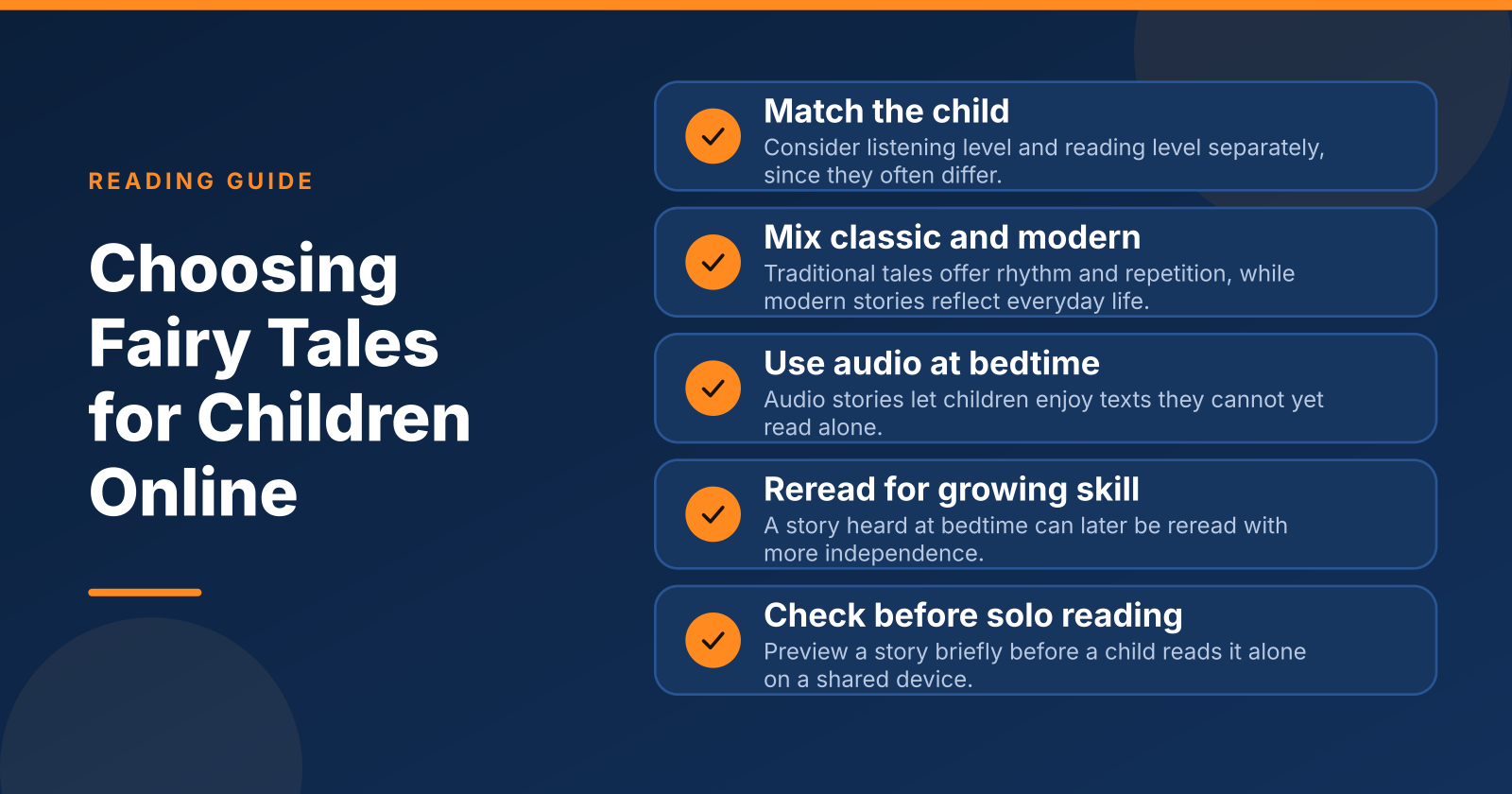
The first question is not which story is best but which story fits the child in front of you. Age matters, but reading stage and attention span matter more, and they do not always move in step. A six-year-old who has only just started decoding may still have the attention of a much older listener, while a confident four-year-old may lose interest in a long plot after three pages. Before opening any library, it helps to ask three simple things: how long can this child listen without wriggling, how much of the text can they read unaided, and what kind of story already holds their interest.
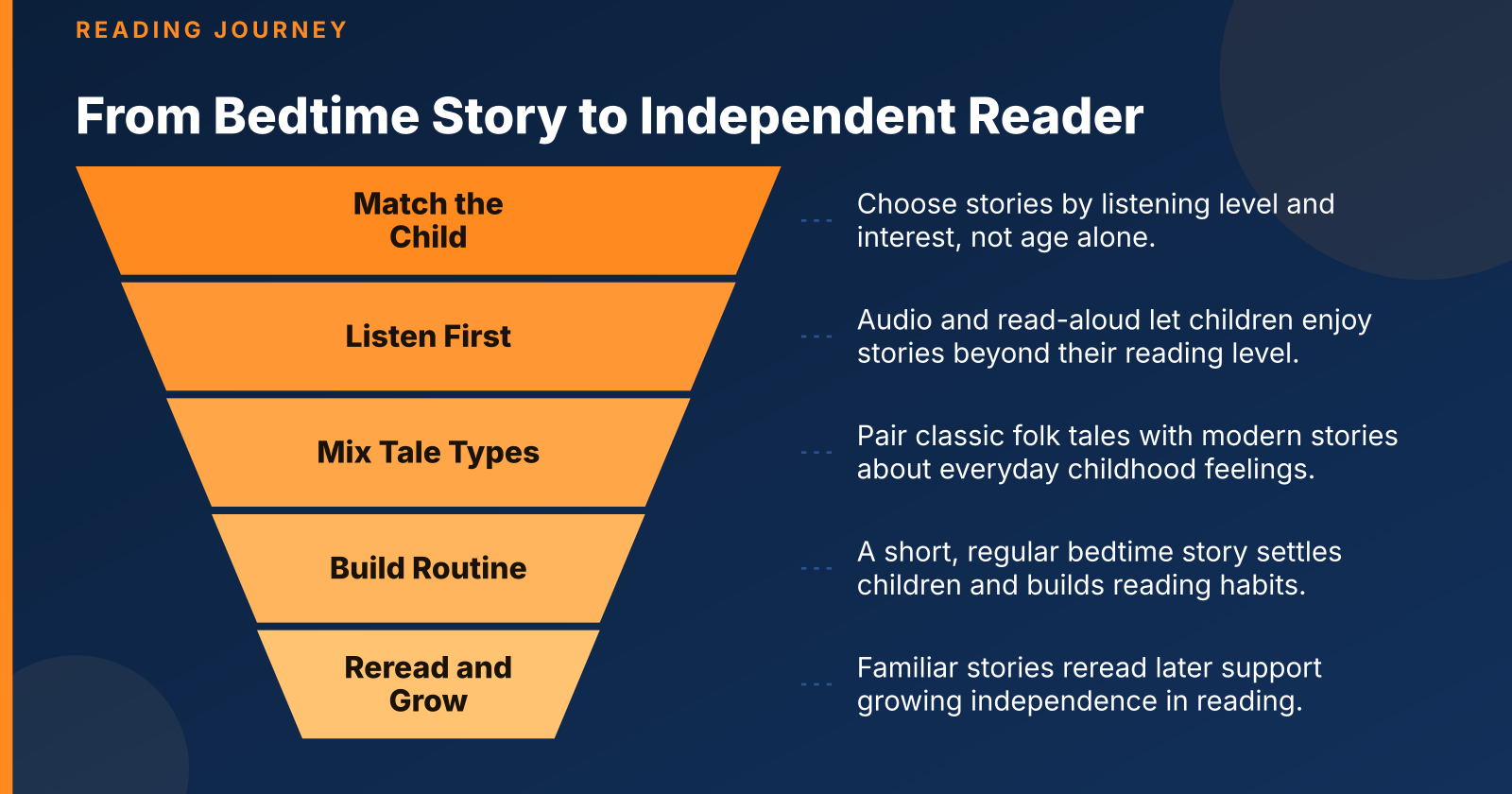
Listening level and reading level are different, and confusing them is one of the most common errors. A child can enjoy a complex fairy tale with rich vocabulary and layered characters long before they can decode it on the page. This is why audio versions and read-aloud sessions are so useful: they let a child take part in a story they could not yet read alone. Many families find that a story heard at bedtime becomes a story reread later with growing independence, which is exactly the progression early literacy specialists hope for.
It also helps to distinguish between classic folk tales and modern fairy tales written for today’s children. Traditional tales from the Grimm brothers, Hans Christian Andersen and the long oral tradition of British folk stories carry rhythms, repetitions and moral structures that many children respond to well. Modern stories tend to offer everyday settings, diverse characters and plots that address anxieties children actually have, such as starting school, a new sibling, or a friend falling out. A useful household or classroom mix often includes both, so children learn the shape of a classic tale while also seeing their own lives reflected in print.
Matching stories to age and reading stage
For children aged three to five, the best stories are short, repetitive and carried by strong illustrations. A text of a few hundred words, with a refrain the child can join in with, gives them a sense of control and anticipation. The pictures do much of the work of telling the story, so a child can follow the plot even when the words are beyond them. Parents often find that the same book is requested night after night, and this repetition is not a problem to solve but a sign that the child is building vocabulary and sequencing skills.
For children aged six to eight, longer plots, chapter-based stories and prompts for independent reading become valuable. At this stage a child can hold a storyline across several sittings, predict what happens next and notice when a character changes their mind. Look for stories that pause at natural points, because a chapter ending is a good moment to ask what the child thinks will happen. Stories with more dialogue can also help children practise expression when read aloud, which matters for later comprehension.
These age bands map reasonably well onto the expectations of the Early Years Foundation Stage in England, which covers children from birth to the end of reception, and onto Key Stage 1, which covers Years 1 and 2. Reception and Year 1 teachers typically look for stories that support phonics progression, so a child working on a particular sound benefits from texts that include that sound often. Childminders registered under Ofsted follow the same framework, which means a library that can be filtered by age or reading level is far more practical than one that offers only a single long list.
The best bedtime story is the one a child will ask for again tomorrow, and that usually means the one they can follow without struggling and enjoy without being talked down to.
Classic versus modern stories
Classic fairy tales offer a shared cultural vocabulary. A child who knows the outline of Jack and the Beanstalk or the Three Little Pigs will recognise the patterns of later stories and pick up allusions in books, films and playground games. Their structures, with a clear problem, a test and a resolution, are excellent for teaching children how narratives work. Many traditional tales also include darker elements that adults have softened over time, and parents often choose a version according to their child’s sensitivity.
Modern stories bring different strengths. Contemporary writers can place a character in a flat above a corner shop in Leeds, a school with a new language being spoken in the playground, or a family with grandparents who live far away. These settings make the fantastical elements feel closer to home, and they allow children to see a range of families and backgrounds in the books they read. For children who are not yet confident readers, seeing themselves in a character can be a powerful motivator.
Deciding on a mix depends on the household or classroom. A family with a strong interest in folklore may want to build around traditional tales and use modern stories as a bridge to everyday life. A nursery or reception class might lean towards modern stories with clear illustrations and strong, relatable characters, saving the older folk tales for children who have built some confidence with narrative. Neither approach is correct in isolation; the value comes from variety and from talking about the stories together.
Criteria for Evaluating a Free Online Fairy Tale Library
Writing quality is the first criterion, and it is more measurable than it sounds. Look at sentence length, vocabulary and the rhythm of the text when read aloud. A good read-aloud story has sentences that a parent can say in one breath, a few words that a child will not know but can work out from context, and a natural pattern of speech. If you find yourself stumbling over clumsy phrasing or long chains of clauses, a child will notice too, even if they cannot name the problem.
Illustration quality matters because pictures can either support the story or compete with it. Strong illustrations show what the text does not say, reward close looking and give children clues about character and mood. Weak or cluttered images can distract, especially on a small screen where detail is lost. When you preview a library, check whether the pictures help a child follow the sequence of events, and whether they match the tone of the words.
Audio narration needs its own assessment. Listen to a sample before committing: consider the accent, the pacing, the use of different voices for different characters, and whether the recording is a full reading or a dramatised version with sound effects. A slow, clear narration can help a struggling reader follow along, while a fast or flat one may leave them behind. Some children prefer a dramatised version with music, others find it overstimulating, so it is worth testing with your own child rather than assuming.
Navigation decides whether a library is useful on a busy evening. You should be able to sort stories by age, length and theme without endless scrolling, and the search should work reliably. On mobile phones and tablets, which most UK families use for reading at home, pages should load quickly on a standard home broadband connection or mobile data plan, and text should resize without breaking the layout. A library that is slow or fiddly on the device you actually have will be abandoned, however good its content.
Checking the terms of free access
“Free” can mean several things online. Some sites offer genuinely free reading with no conditions. Others offer a free trial that expires, show the first chapter and then ask for payment, or are funded by advertising that interrupts the story. Read the terms before you rely on a library, and look for clear statements about what costs money and what does not. A page that hides its pricing or buries it in small print is a warning sign in its own right.
-
Check whether the stories you want are fully readable without a subscription, not just previewed.
-
Look for advertising, especially pop-ups, video adverts or links that leave the site.
-
Find out whether third-party links or embedded content could take a child to pages they should not see.
-
Review how the site collects data, including whether it asks for accounts, birthdays or contact details from children.
-
Confirm whether audio and illustrations are included in the free version or only in paid tiers.
Before a child uses any site unsupervised, the most important step is to test it yourself. Open it on the device they will use, click through several stories and watch for anything that would concern you. Think about whether a child could reach a page they cannot yet understand, or be prompted to share information. The safest arrangement for younger children is a shared device used in a common room, with an adult nearby.
UK GDPR and the Age Appropriate Design Code, often called the Children’s Code, are relevant when you judge a children’s site. The Children’s Code, enforced by the Information Commissioner’s Office, sets out expectations for services likely to be accessed by children, including default privacy settings, limits on profiling and clear, age-appropriate explanations of data use. You do not need to read the legislation in detail, but you can ask simple questions: does the site collect more data than it needs, does it explain this in language a parent can understand, and does it avoid nudging children towards sharing more.
Using Online Fairy Tales in Practice: Step-by-Step Routines
A bedtime routine built around online stories works best when it has a clear shape. A reasonable pattern is fifteen to twenty minutes on a shared device, in the same place each night, with the screen placed on a table rather than held in a child’s hands. Keeping the routine predictable helps children settle, and it means the story becomes a signal that the day is ending rather than another screen session competing with sleep. Parents looking for bedtime stories for kids can start with a collection that lists each tale’s approximate reading level and length, so they can match the text to the child’s stage and the time they have before lights out.
A simple read-aloud sequence can make a big difference. Start by previewing the pictures together and asking the child what they think the story is about. Read the first section, then pause to ask what might happen next, which builds prediction and attention. When the story ends, invite the child to retell it in their own words, perhaps using the pictures as prompts. This retelling is one of the most useful parts of the routine, because it shows what the child has understood and where they might need more support.
Audio stories can sit alongside a printed book, which is especially helpful during car journeys and school runs. A child who listens to a story on the way to school may recognise the same characters when they open the book at home, and the two forms reinforce each other. Audio is also useful when a parent is tired or unwell, though it should not replace reading aloud entirely, because the closeness of a shared voice carries its own benefits.
How long to spend per session depends on age and attention. Three- to five-year-olds usually settle best with a single short story, while six- to eight-year-olds may manage a chapter or two. Notice when a child begins to fidget, ask unrelated questions or lose the thread of the plot, and stop there rather than pushing on. Readiness for independent reading tends to show when a child starts reading familiar words without prompting, asks to read a page aloud, or picks up a book on their own during quiet time.
Making it work in a classroom or childminding setting
In a classroom, projecting a story on an interactive whiteboard turns a shared text into a whole-class experience. Children can point to words, predict events and discuss illustrations together, and the teacher can pause to model questions about character and setting. Choose a story that matches the phonics focus of the week, so that the sounds children are learning appear naturally in the text. Keep the screen size and sound level in mind, because a story that works for one child at a desk may be hard to follow from the back of a large room.
A short listening rota fits well into a typical school day. Ten minutes after lunch or before home time is often enough for a story, and rotating the choice of text among children gives each one a sense of ownership. For childminders working with mixed ages, a rota can alternate between picture-led stories for the youngest and longer chapters for older children, so no one feels left out.
Online stories are most useful when they connect to reading schemes already in use. If a school uses a structured phonics programme, a teacher can select stories that reinforce the same sounds and high-frequency words. Linking the digital story to the printed book the child takes home creates a continuous experience across school and home. The aim is consistency rather than novelty, because children learn best when the same ideas come back in different forms.
Common Mistakes and How to Avoid Them
Choosing a story by length alone is a frequent error. A long story can look impressive, but an early reader who struggles through it will quickly lose confidence. Check the reading level and the amount of text on each page before selecting, and remember that a shorter story read well is often more valuable than a longer one read in a rush. Matching the story to the child on the day matters more than matching it to a label on the website.
Letting children read unsupervised on sites with advertising or unclear data practices is another common problem. Even well-meaning sites can carry adverts that a child cannot distinguish from story content, and data forms can ask for information that a child should not share. Keep an adult nearby for younger children and review the site with older children so they understand what to click and what to avoid.
Relying only on screens misses the benefits of shared, physical books. A printed book can be handled, returned to, and carried from room to room, and it allows a child to see the full spread of illustrations at once. Children also learn about book conventions, such as turning pages from front to back, by handling real books. A balanced approach uses online stories as one part of a wider reading life that includes library visits and bookshelves at home.
Reading too fast or skipping illustrations weakens comprehension and vocabulary. Children need time to look at pictures, to connect words with images and to ask questions. A parent who races through a story to reach the end may find that the child has no idea what happened. Slow down, allow pauses and let the child lead the discussion when they have something to say.
Assuming that “free” means no hidden cost is a mistake many families make. Free reading can still use up data allowance on a mobile plan, fill device storage with downloaded audio, or take time away from sleep. Check the data use if you rely on mobile connections, and be aware that downloaded files can accumulate on a tablet that is already short of space.
Warning signs that a site is not worth using
Some signs appear quickly. A library that asks a child for a full name, school, or photograph without a clear reason should be avoided. Sites that push children towards purchases with countdown timers or repeated pop-ups are designed to pressure rather than to read. Stories that appear suddenly cut off at the most exciting moment, with a demand for payment, are not really free to read.
Other signs take longer to notice. Illustrations that are inconsistent or poorly reproduced, audio that drops out or sounds rushed, and text that contains frequent spelling or grammar errors suggest that the library has not been carefully edited. A site with no clear contact details, no information about its authors or no privacy statement deserves caution. If a library is hard to navigate on the devices you use, it will frustrate both you and your child over time.
The strongest signal of a good library is consistency. Stories should be clearly labelled by age and length, the writing should be carefully edited, the illustrations should support the text, and the terms of access should be easy to understand. When you find a library that meets these tests, return to it with confidence, but keep checking as it changes. A good fairy tale collection is one that children want to revisit, and a good routine is one that adults can keep up on ordinary weeknights in Birmingham, Bristol or Belfast alike.
Choosing fairy tales to read online for free comes down to a few practical judgements: the child’s reading stage, the quality of the writing and pictures, the honesty of the terms of access, and the routine that makes the stories part of everyday life. Start with a single short story, read it together, and notice what the child asks for next. That response will tell you more than any list of features. Over time, a well-chosen library can become a dependable part of bedtime, the place where a child learns that stories are worth the wait and that reading is something to share.