
Read Free Fairy Tales Online for Kids of All Ages
Read Free Fairy Tales Online for Kids of All Ages
By Emily Carter
Fairy Tales for Children You Can Read Online for Free
Every parent knows the moment when a child asks for “one more story” and the request turns into a nightly ritual. Finding the right fairy tales for children to read online for free has become one of the easiest ways to make that ritual both enjoyable and useful. Modern Fairy Tales is a library of modern children’s fairy tales with illustrations and audio, built for kids and parents who want quality stories without a paywall or a registration hurdle. Whether you are looking for a short story before bed or a longer tale to follow across several evenings, the collection is organized so that you can start reading within a minute. Many families first come across the site while searching for bedtime stories, and what they usually discover is a wider library than they expected, with stories written for different ages and different moods.
This guide takes a practical look at how to choose, read, and evaluate online fairy tales. It does not stop at listing titles. Instead, it explains what to look for in a story, how to structure a reading session that a young child can actually follow, why modern texts differ from the classics most of us grew up with, which mistakes parents make when they move reading onto a screen, and how to tell whether the routine is working. The aim is to give you working criteria you can apply to any free collection, including the one on Modern Fairy Tales, so that your decisions rest on evidence from your own child rather than on popularity charts.
Choosing Fairy Tales for Children to Read Online Free
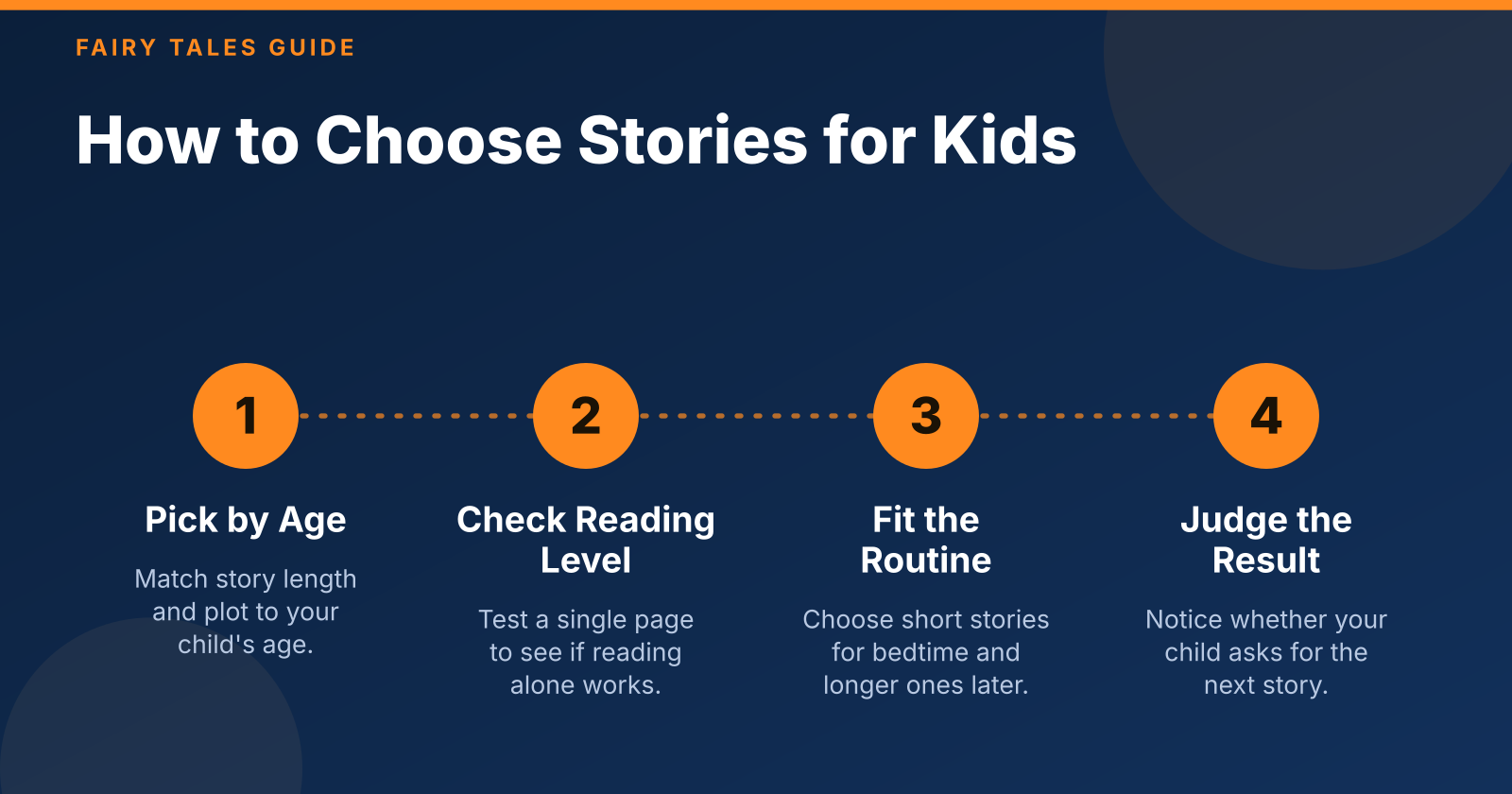
The first question is never “which story is best?” but “which story fits this child right now?” A fairy tale that delights a five-year-old can bore an eight-year-old or confuse a three-year-old who is still sorting out cause and effect. Age groups are a useful starting point. Preschool children, roughly three to five, respond well to short narratives with a clear repeated pattern, a small number of characters, and an obvious problem that gets solved by the end of the page. Early readers, often six to seven, can follow longer plots with a few subplots and begin to enjoy stories where they can predict what comes next. Children aged eight to twelve handle complex motives, ambiguous characters, and emotional stakes that unfold over several chapters.
Reading level matters as much as age. A child who reads independently at a second-grade level will struggle with a text full of rare words even if the story itself is simple, and a strong reader of ten may still want the emotional depth of an older story. When you read aloud, you can adjust on the fly. When a child reads alone, look at a single page: if they stop more than two or three times per paragraph to decode words, the text is probably too hard for independent reading, though it may still work as a read-aloud.
When you evaluate a free collection, several criteria separate useful material from filler. Story length is the most visible one. Stories between 300 and 800 words suit most bedtime routines, while longer tales work better split across several sessions. Moral content deserves attention too. Some modern stories state their lesson openly, which can help younger children name feelings, while others leave the moral implicit and invite discussion. Neither approach is wrong, but a child who is told the lesson at the end often stops thinking about it, whereas a child who has to work out what the character learned keeps talking about the story for days. Vocabulary is the third criterion: look for a mix of familiar words and a handful of new ones introduced in context, which is how children expand their range without being overwhelmed. The fourth is cultural range. A collection that includes characters from different backgrounds, family structures, and traditions gives children a wider view of the world and lets them recognize themselves in more stories.
Classic and modern stories serve different developmental needs, and the best approach is usually to mix them. Traditional tales, with their clear good and bad characters and their predictable sequences of trials, give young children a stable framework for understanding how stories work. Their archetypes are easy to remember and retell. Modern stories often complicate this picture: heroes make mistakes, villains have reasons, and problems are solved through cooperation rather than magic or a single act of courage. For children between six and ten, who are beginning to understand that people are not simply good or bad, modern texts can open useful conversations. The collection on Modern Fairy Tales includes both styles, so you can start with a familiar structure and gradually move toward more layered narratives as your child grows.
How to Read Fairy Tales Online Free: A Step-by-Step Workflow
A reading session works best when the setup is deliberate. Begin with the device. A tablet or laptop placed at a comfortable distance, with the text large enough to read without leaning in, reduces strain and keeps the child focused on the story rather than on the screen. Set the screen brightness lower in the evening, since a bright display right before sleep can make it harder for children to wind down. Many devices have a night or warm-light mode that does this automatically. Decide on a time limit before you start, and keep it consistent across nights. For young children, ten to fifteen minutes of screen-based reading is usually plenty; for older children, twenty minutes followed by a few minutes of talk is a reasonable ceiling.
Illustrations and audio are not extras to be skipped over. They are tools for comprehension. For a child who is still learning to decode, an illustration can confirm what a sentence means: if the text says a character is “hiding behind the tree,” the picture shows exactly where. Pausing on an image and asking what the character is feeling is one of the simplest ways to build emotional vocabulary. Audio versions serve a different purpose. A narrator who changes voice for each character helps children track who is speaking, and hearing fluent reading models rhythm and intonation. A useful pattern is to read the text first, then play the audio version of the same story the next night, so the child hears a story they already know and can follow the words along with the narration.
Estimating time per story helps you plan the routine. A preschooler will usually sit with a 400-word story for about five to seven minutes, including interruptions and questions. An early reader working through a story of similar length on their own might need eight to twelve minutes. Children aged eight to twelve often finish a 1,000-word story in ten to fifteen minutes and then want to talk about it. Building a routine of ten to twenty minutes means choosing a story length that fits within that window and leaving a few minutes at the end for one question: what did you think would happen next? Keeping the structure the same every night, even when the story changes, helps children settle faster, because the routine itself becomes a signal that it is time to slow down.
Modern Fairy Tales Versus Traditional Texts: Key Differences
Traditional fairy tales tend to follow a tight structure: an initial state of balance, a disruption, a series of trials, and a restoration of order that often comes with a reward or punishment. Character roles are usually fixed. The heroine is good, the stepmother is cruel, and the magical helper appears at exactly the right moment. Resolutions are typically decisive and final, with the hero marrying, inheriting a kingdom, or returning home transformed. This clarity is part of their appeal for young children, who benefit from predictable patterns and clear moral signals.
Modern stories usually loosen that structure. The protagonist may begin with a flaw that the story does not fully fix, or the conflict may be between two characters who both have valid needs. Resolutions often come from negotiation, honesty, or a change in how a character understands a problem, rather than from a sudden stroke of luck. Endings can be open, leaving room for the child to imagine what happens after the last page. These differences change what a child takes from a story. A classic tale teaches recognition of patterns; a modern one teaches how to weigh different perspectives.
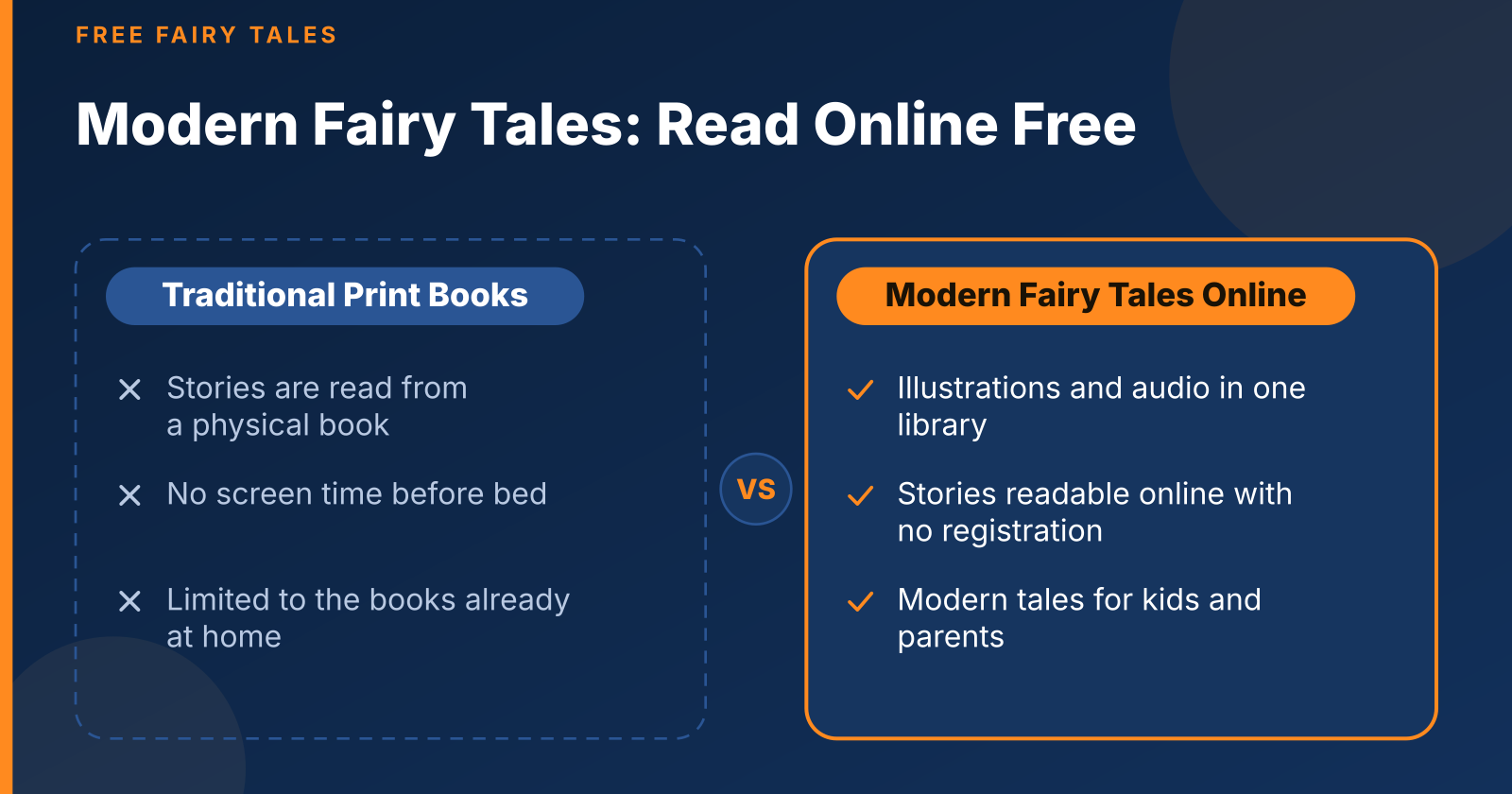
Modern collections also cover themes that older texts rarely addressed directly. Diversity is one: stories feature families with different languages, abilities, and traditions, and show these as ordinary parts of life rather than as special topics. Emotional literacy is another. Modern texts often name feelings such as jealousy, fear, or disappointment, and show characters working through them, which gives children words for their own experiences. Environmental themes appear too, with stories about animals losing habitat, communities caring for shared spaces, or characters learning to reduce waste. Each of these themes supports different learning goals, and it is worth matching them to what you want your child to practice.
Choosing between formats depends on the goal. If you want to build familiarity with story structure and sequencing, traditional tales are an efficient choice, because their patterns are easy to spot and retell. If you want to develop empathy, discuss ethical choices, or talk about emotions, modern stories give more material to work with, since the characters’ motives are rarely simple. If the goal is language development, either format works, but illustrated and audio versions add a layer of support that is especially useful for children who are still building vocabulary. Comparing a story against these criteria before you read it makes the choice much more deliberate than picking whatever appears first in a list.
A story that a child can retell in their own words, with one thing they would change about it, is doing more work than a story that was merely finished.
Common Mistakes When Reading Children’s Stories Online and How to Avoid Them
The most frequent mistake is choosing stories by popularity alone. A title with thousands of views may be perfect for some children and wrong for yours. Popularity reflects the tastes of many different readers at many different ages, and it says nothing about whether a story matches your child’s current reading level, emotional readiness, or interests. A better habit is to check three things before reading: the approximate age range the story suits, the length, and whether the central problem is one your child has encountered in their own life. If you cannot judge this from the summary, read the first page together and decide from there. For parents who want a calm end to the day, a collection of bedtime stories can be easier to choose from when each tale is labeled by length and reading level, so you can pick something short for a tired evening or a slightly longer one for a weekend.
The second mistake is passive screen consumption. When a child watches or listens to a story with no interaction, the experience tends to end when the story ends, and little of it stays with them. Passive reading is not useless, but it misses most of what makes stories valuable. Simple interventions change this. Ask the child to predict the next event before you turn the page. Pause after a difficult sentence and ask what it meant. At the end, ask the child to retell the story in three sentences, or to describe their favorite character to someone who has not heard it. These five-minute conversations turn a screen experience into a reading experience.
The third mistake concerns source reliability, licensing, and copyright. Free texts online vary widely in quality. Some are carefully edited and credited to named authors; others are copied from unknown sources with typos, altered content, or missing attribution. Before relying on a collection, look for clear author information, a stated publication date, and a visible terms-of-use page. Freely accessible reading on a children’s platform should make its rights status clear to parents. If a site offers no information about who wrote its stories or who holds the rights, that absence is itself a signal to proceed carefully and to compare its texts with a second source before building a routine around them.
-
Check the age range and story length before choosing, rather than relying on how many people have read a title.
-
Build one interactive moment into every session, such as a prediction, a pause for a question, or a short retelling.
-
Confirm that the platform names its authors, shows publication details, and states its terms of use.
-
Read the first page with your child before committing to a whole story, so that a poor fit can be dropped quickly.
What Modern Fairy Tales Platforms Help Users Accomplish
A useful online library reduces the time spent searching and increases the time spent reading. The catalog organization on a platform like Modern Fairy Tales matters for this reason. When stories are grouped by age, length, or theme, parents can find a suitable title in a few clicks instead of scrolling through hundreds of unsorted entries. Filters let you narrow the selection to stories that fit a specific night: a short one for a busy evening, a longer one for a weekend, or a story about a particular emotion when your child is working through a difficult day. This kind of organization turns a large collection into a usable one.
Access to multiple formats in one place is another practical advantage. A child who prefers reading may use the text, while one who learns best by listening can use the audio, and a visual learner can start with the illustrations. Having all three formats for the same story means a family can switch between them without searching elsewhere, and a child can move from listening to reading as their confidence grows. The illustrations also help children who are still building vocabulary, since the picture carries part of the meaning and reduces frustration.
Reading without registration barriers saves time and removes a common reason to give up. If a parent must create an account, verify an email, and confirm preferences before reading a single story, the routine often never begins. Platforms that let users read freely can still offer features like saving favorite titles, which makes it easy to return to a story a child loved and to repeat it when they ask. Repetition is valuable in early childhood: children often want the same story many times, and each reading brings out new details they did not notice before.
Measuring Results: How to Tell if Online Reading Is Working
Progress shows up in what children do after the story ends. The clearest indicator is retelling. A child who can describe the main events in order, name the main character, and explain the problem has understood the story. Questions are another useful sign. When a child starts asking why a character made a particular choice, or what would happen if the story had gone differently, they are thinking about the text rather than just following it. Vocabulary use matters too: if a child begins to use a word from a story in a new context, the reading is building language in a way that will stick.
When these signs appear, the difficulty can be raised gradually. Move from a short story to a longer one, or from a story with a single problem to one with two interacting conflicts. If retelling becomes vague or the child loses interest halfway through, step back to a simpler text for a few nights. Frequency should also match the child’s response. For some children, a story every night is ideal; for others, three or four stories a week, with the rest of the time spent on other activities, works better. The right balance is the one that keeps the child asking for more without making reading feel like a chore.
Online reading should sit alongside offline reading and a consistent sleep schedule, not replace them. Printed books have a physical presence that screens do not, and many children find it easier to focus on paper for longer periods. Alternating between a screen-based story on one night and a printed book the next gives children exposure to both forms. The screen should also end at a fixed point before bed, with enough time left for the child to settle. A reasonable pattern is to finish the screen portion at least thirty minutes before lights out, then spend the last few minutes with a quiet activity such as talking about the story or looking at a picture book together.
Conclusion
Reading fairy tales online for free can be a genuinely good habit when it is built on clear choices. Start by matching each story to your child’s age, reading level, and current interests, and judge it by its length, its moral content, its vocabulary, and the range of people and experiences it shows. Mix classic and modern texts so that your child learns the patterns of traditional stories while also developing the ability to weigh different perspectives. Structure each session with a calm setup, use illustrations and audio as comprehension tools, and keep the routine within a fixed window of ten to twenty minutes. Stay alert to the common mistakes: do not choose by popularity alone, do not let reading become passive, and check that any free source is clear about its authors and rights.
Measure results by what your child does after the story, through retelling, questions, and new words, and adjust difficulty and frequency as they grow. Keep online reading in balance with printed books and with a steady bedtime. Platforms such as Modern Fairy Tales make this easier by offering a large, organized, and open library of illustrated and audio stories. The real measure of success, though, is simple: a child who asks for one more story tonight, and who can tell you what happened in the last one.